A Practice for Remembering What They Are Trying to Make You Forget
Something quiet is spreading right now across notebooks, secondhand bookshops, and the corners of Substack and TikTok where people still write by hand. It is being called commonplacing which is an old discipline of copying down what moves you, what teaches you, and what you don’t want to lose. Francis Bacon kept one. So did Marcus Aurelius, whose private notebook became the Meditations. John Locke published an entire method for it in 1685. The practice surges every time a civilization drowns in more information than it can hold, and it is surging again right now, for the same reason it always has.
But a commonplace book, in its traditional form, collects what already moved you. It gathers the words of others, like quotes, passages, or lines that struck a chord, all into one place, like a scrapbook of borrowed wisdom. What I am asking the imaginal cells of this movement to build is a different instrument. Not a scrapbook of what inspired you. A record of what a subject did to you and to the truth over time, kept long enough to watch the story change.
I call it a Witness Book.

One Topic. One Small Book. A Lifetime to Fill It.
Choose a single subject. One that unsettles you, one you were taught something specific about, or one you suspect is not what it appears. Vaccines. The food system. A war. A currency. A religious doctrine. A piece of your own family history. Anything happening in your environment. Even simple things like how the food from the store tastes different. Or something inspiring like regenerative movements. (I will include a non-comprehensive list of ideas to spark your writing momentum at the end of this article). Pick a small, humble, homemade book and give that subject the whole thing, cover to cover, for as long as you’re alive to keep adding to it. Write in it, cut out pictures for it or draw them, find articles and quotes for or whatever comes to your imagination.
Do not try to finish it in a weekend. The Witness Book is not a project. It is a companion you return to for years, sometimes decades, the way a garden is returned to rather than completed.
The Stages of the Working
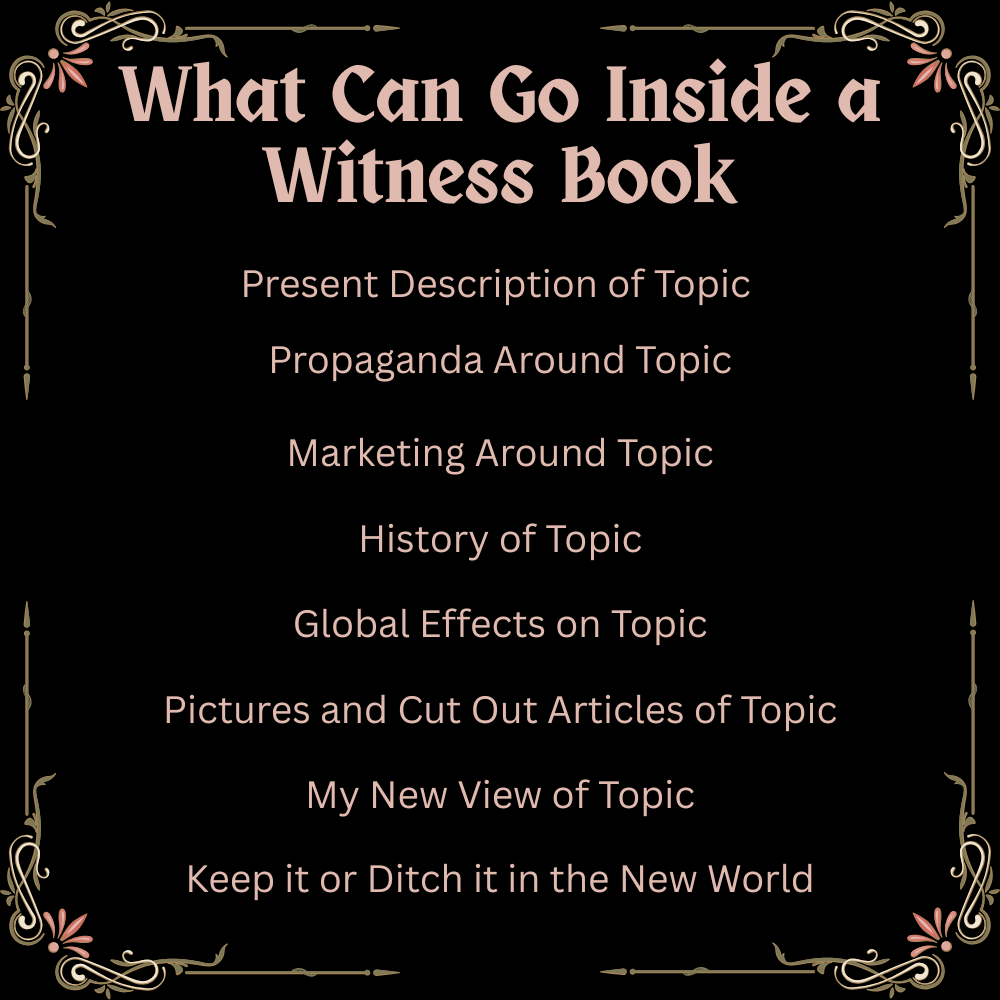
Move through these stages in order the first time. After that, move through them in whatever order the subject demands, and circle back as often as new information surfaces.
- Write down what you know right now, today, before you research anything further. What were you taught? What did you accept as simply true, without ever examining it? Get it on the page in your own words, unedited, even where it embarrasses you.
- Go looking for other opinions on the same subject. Genuinely different ones, not the ones that merely confirm what you already believe.
- Find whoever is naming the lies or the corruption inside that topic. The whistleblower. The dissenting researcher. The one who got pushed out of the institution for saying the wrong thing at the wrong time.
- Seek a perspective from somewhere else on this earth entirely. A different country, a different tradition, a different lineage of thought that never had to answer to the same authorities yours did.
- Journal the propaganda itself. Not just the topic, the selling of the topic. Notice the language used to move you, the fear used to move you, and the shame used to move you. Write down how it’s being marketed to you, and by whom.
- Trace the subject back to its root. Read the old books. Find the moment the idea first entered the record. And follow the thread from there to now.
- Decide, in your own handwriting, what belongs in the world that’s coming. Keep it whole. Keep only a fragment as foundation for something better. Or release it entirely.
- Return. Whenever something new crosses your path, a headline, an old letter, a conversation, or even a memory that resurfaces, open the book again and add to it.
The Shock and the Grief Belong on the Page Too
Some entries will start from a jolt. Something you learn that rearranges what you thought was solid ground. Let the shock be part of the record; it is data, not a detour. Other entries will begin from love. Something worth defending, worth keeping alive inside the new world rather than letting it be discarded along with everything else the old world built. Both belong in the same book. The Great Transition is not sorting the world into things that were all good or all corrupt. It is asking each of us to sit with one subject long enough to tell the difference, piece by piece.
A Practice That Widens as It Deepens
Watch how a single topic gets used against you. The way it’s marketed or weaponized in an argument. The way a headline about it makes your chest tighten before you’ve even finished the sentence. That reaction belongs in the book as much as any fact you find. And once you’ve been keeping a Witness Book for a while, you’ll start noticing others circling the same subject. In your Facebook groups, in your sector coven, or at your kitchen table. Let those conversations feed the book. This was never meant to be done in isolation. The isolated island in a chart still needs bridges, and a shared subject is one of the strongest bridges there is.
What Gets Handed Down
A shelf of these small books, each one devoted to a single thread of the old world’s story, becomes something rarer than an inheritance of money or property. Your children, your nieces and nephews, your neighbors, etc, will inherit a record of what the world tried to convince a generation of. And what that generation refused to simply accept. They inherit the difference between what was taught and what was actually true, already traced, already sourced, and already sat with long enough to be trusted. That is a different kind of wealth to leave behind.

Where This Lives in the Curriculum
The Witness Books belong to Agape Emergence because this is what magic in everyday life actually looks like. Not incense and candlelight alone, but the ordinary, patient labor of clear sight, kept sacred through repetition. Each of the fifteen sectors in transformation could carry its own Witness Book. One for medicine, one for education, one for currency, one for governance, and so on. Over the coming months, we will start exploring how to put some books together. We will start looking at ways to judge the source of your information. Even bad sources have something to offer. A lot can be said about what is getting attention, and what the community is believing.
This Belongs on the Air, Too
This practice is built for a podcast as much as for a page. Picture a recurring segment where one Witness Book, one subject, gets talked through out loud. The belief someone was raised with, and the opposing view they went looking for. The whistleblower they found, and the old book that traced it back to its root. And the decision they finally wrote down about what deserves to survive into the new world. Listeners bring their own half-finished books to the conversation. Over a season, the show becomes its own kind of Witness Book. A spoken record of a community learning, together, what to keep and what to release. Many of these podcasts or videos could spread a movement of documenting the Great Transition. (Check out our list of ideas at the end of this article and start brainstorming a list for yourself and those who journal with you).
Begin with one small book tonight. One subject. One page of what you currently believe, written before you research another word. The rest of the working can wait until tomorrow, the page cannot.
The crossroads are here. The torches are lit. Let’s write it down.
Blessed Be
Kristi
High Priestess of Agape Covens
Founder, The Crossroads Movement